How to Choose Your First Fliteboard
Board volume, wing size and battery range are the three decisions that shape your first year of flying. Here is how we guide riders through them in Mayakoba.

Choosing a first Fliteboard is not really a decision about a board. It is a decision about the kind of riding you want to be doing twelve months from now. Riders who buy for the person they are on day one usually outgrow the setup within a season. Riders who buy for the person they intend to become tend to keep the same board for years and simply change the parts around it.
That is the framing we use with every guest who walks into our Mayakoba centre. Below is the same conversation, written down.
Start with the water you actually ride
Before volume, before wings, before battery capacity: where will this board spend its life? Flat, protected lagoon water rewards a very different setup than open ocean swell. A rider who launches from a resort dock into sheltered water can go smaller and more responsive sooner. A rider who wants to chase wind chop or ride waves needs a platform that forgives the moments when the surface is not co-operating.
Be honest about frequency too. A board ridden three times a week develops a rider quickly, and a slightly demanding setup accelerates progression. A board ridden on holiday, twice a year, should be the easiest thing in the world to stand on.
Buy for the rider you will be in a year, not the rider you are on day one.
Board volume: stability versus agility
Volume is the single most visible trade-off in the lineup. More volume means the board floats higher at rest, which makes the kneeling start easier, the first stand-up calmer and the inevitable early falls less punishing. Less volume means less swing weight in the air, faster turn initiation and a board that feels connected to the foil rather than sitting on top of it.
Most first-time owners are best served by staying one step more stable than their ego suggests. The extra litres cost almost nothing in top-end performance during the first season, and they buy dozens of extra minutes of flight time in the weeks when those minutes matter most. If you are already a surfer, kiter or wake rider, you can reasonably step down — board sports transfer well, particularly the instinct to look where you are going rather than at your feet.
Rider weight matters here more than height. Two riders of identical height and thirty kilos apart will experience the same board completely differently, which is why we weigh the conversation on real numbers rather than general categories.
Wings: the part you will change first
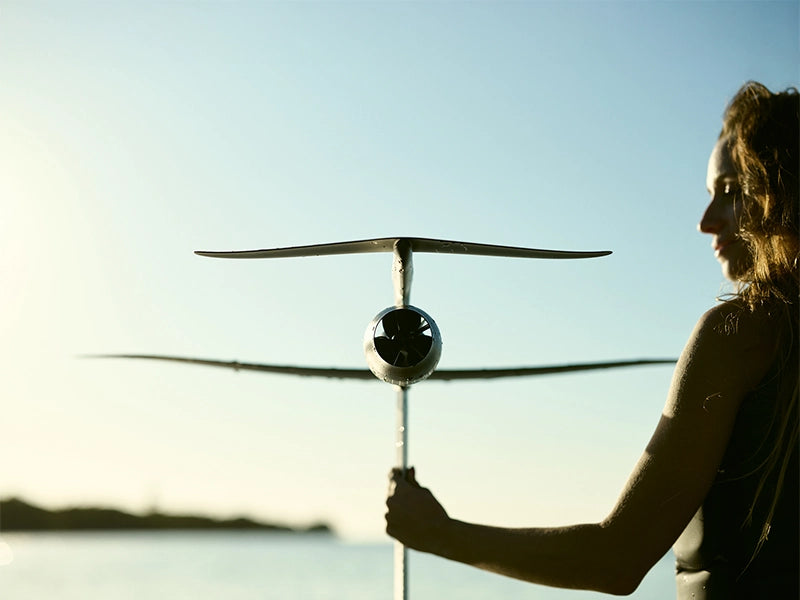
The front wing is the part of an eFoil that most changes how it feels, and it is also the cheapest thing to swap. A large, high-lift wing flies at low speed, comes up early and is enormously forgiving — exactly what a new rider wants. A smaller, higher-aspect wing needs more speed to fly but gives glide, efficiency and the ability to carve hard without stalling.
This is why we tell new owners not to over-invest in the board and under-invest in the wing selection. Buy the platform that suits you, then plan on adding a second wing at some point in your first year. That single upgrade will feel like a new board.
- Large high-lift wing: earliest take-off, lowest speed, most forgiving. Ideal first wing.
- Mid-size wing: the everyday choice once you can ride toeside and heelside turns comfortably.
- Small or high-aspect wing: speed, glide and tight carving. Rewarding once flight is automatic.
Battery: range you will actually use
Battery choice is a balance between flight time and weight. A larger battery extends a session; a smaller one lightens the board, which changes how the whole package feels both in the air and when you are carrying it down a dock.
New riders almost always overestimate how long their first sessions will last. Standing, falling, climbing back on and standing again is physical work, and most first-timers are ready to stop long before the battery is. As technique settles and the falls become rare, session length climbs — and that is the point at which extra capacity starts to earn its weight.
Our practical advice: choose the battery that matches the sessions you will have in year two, not the sessions you will have in month one. And whichever you choose, treat it well. Battery health is the single largest factor in the long-term value of an eFoil, and it is almost entirely determined by charging and storage habits.
Try before you decide
There is no substitute for standing on the equipment. Specifications describe an eFoil accurately and tell you almost nothing about how it will feel under your feet. Two boards with similar numbers can have completely different personalities.
That is the reason we keep the current range available to ride in Mayakoba. A test ride costs an afternoon and routinely changes the buying decision — usually because a rider discovers they want something more agile than they expected, occasionally the reverse. Either way, the decision gets made on water rather than on paper.
What ownership actually looks like
The last part of the decision is the part most buyers forget: who looks after the board once it is yours? An eFoil is a sealed electrical system operating in salt water. It needs rinsing, correct storage, periodic inspection, firmware updates and occasional genuine parts.
Buying from a certified service centre means the board you ride and the board that gets serviced are known to the same team. We keep records, we track battery health over time, and we can usually tell from a hand controller log what happened before an owner finishes describing it. That continuity is worth as much as any specification on the box.
Questions about any of this?
Our team in Mayakoba answers Fliteboard questions every day.
Book an Experience→