The Future of Electric Hydrofoiling
Where the sport goes next: lighter batteries, quieter drives, wider access — and what that means for riders and for the water they ride on.

Electric hydrofoiling is roughly a decade old as a commercial sport. Very few disciplines mature that quickly, and it is worth being clear about why: the underlying technologies — battery energy density, brushless motor efficiency, composite construction and control electronics — were all improving simultaneously for other industries. The eFoil simply arrived at the intersection.
That same intersection is what shapes the next decade.
Weight is the frontier
Everything good about an eFoil gets better as it gets lighter. A lighter board is more responsive in the air, easier to carry down a dock, easier to load into a tender, and far easier to sell to someone who is unsure about the whole idea.
Most of the remaining weight is battery. Incremental improvements in cell energy density have already produced production boards that would have been impossible five years ago, and that trajectory has not flattened. The interesting consequence is not longer sessions — it is boards light enough to change who rides them.
Every kilogram removed widens the audience more than it improves the ride.
Drives get quieter and more efficient
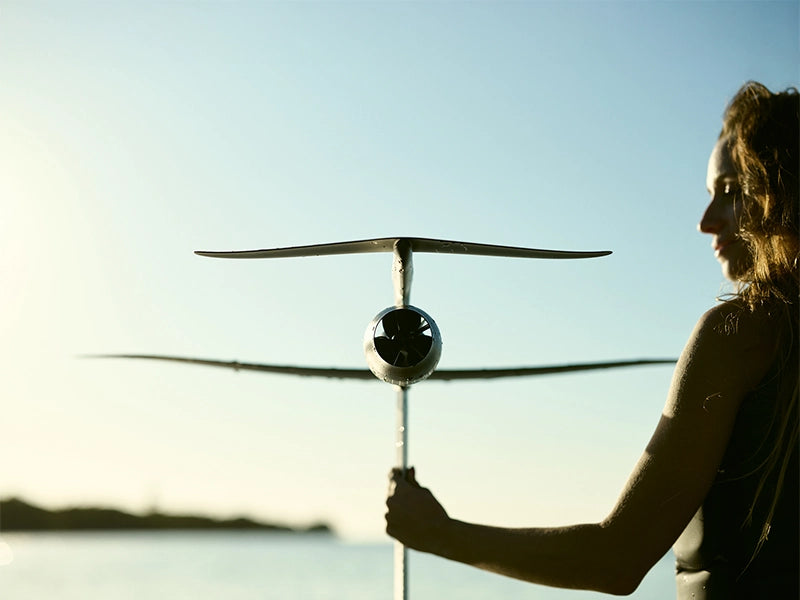
Sealed jet propulsion already removed the exposed propeller, which is the main reason eFoils are permitted in places other powered craft are not. Refinement continues in a less visible direction: efficiency. A drive that converts more of the pack into thrust extends range without adding a gram.
Acoustic refinement matters too. A board that is quiet at cruising speed is welcome in protected water; one that whines is not.
Foils borrow from everywhere
Wing design has moved fastest of all, because it borrows freely from surf foiling, wing foiling, sailing and competitive kite racing. High-aspect wings that glide efficiently, wave-oriented shapes that respond to swell, and modular systems that let one board serve several purposes are now standard expectations rather than novelties.
For riders, the practical result is that a board bought today is far less likely to be outgrown, because progression happens through parts rather than replacement.
Access widens
The most consequential change is not technical. As boards become easier to ride and quieter to operate, the venues that permit them multiply — resorts, protected lagoons, inland waterways, marinas. Access, not performance, is what turns a niche sport into a common one.
We see this directly. The proportion of guests who have never done any board sport keeps rising, and their success rate keeps rising with it.
Racing pulls the technology forward
Competitive eFoil racing has arrived faster than anyone expected, and it plays the role racing always plays: it stresses equipment, exposes weaknesses and pushes development that eventually reaches production boards. Impellers, wing profiles and thermal management all improve under competition pressure.
What will not change
The reason people ride will stay exactly the same. Silence, the absence of a wake, and the specific strangeness of moving quickly above water with nothing visibly holding you up. Every technical improvement is in service of extending that sensation and making it available to more people.
That is a good trajectory for a sport to be on.
Questions about any of this?
Our team in Mayakoba answers Fliteboard questions every day.
Book an Experience→